

An Austin home’s electrical panel is overdue for an upgrade if it trips breakers repeatedly, feels warm to the touch, still uses fuses instead of breakers, or carries a Federal Pacific or Zinsco label, and a licensed electrician should evaluate it before those signs turn into a bigger problem.
Most homeowners never think about their electrical panel until something forces the issue: a breaker that will not stay reset, a burning smell near the laundry room, or a home inspector’s report ahead of a sale. By then, the panel has usually been sending smaller signals for a while. This post walks through what those signals actually look like, so Austin homeowners know what to watch for before a minor annoyance becomes an electrical hazard.
When you are ready for help, start with our electrical panel upgrade services or call the Austin electrical team at (737) 225-8980.
Why panel age alone does not tell the whole story
It is tempting to judge a panel by how old the house is, but age is only part of the picture. A 40-year-old panel that has been properly maintained and was a quality product when it was installed can still be functioning safely. A 15-year-old panel from a brand with known manufacturing defects can be a genuine hazard. What matters more than the number of years on the panel is what is actually happening inside it and whether it can support how the home uses electricity today.
The average home in Austin was built around 1998, according to BestNeighborhood.org, which puts a large share of the metro’s housing stock at roughly 25 to 30 years old, right in the range where original panels start to show real wear. Homes built before the 1990s were also designed around a much lighter electrical load than today’s households actually use. Central air conditioning, electric ranges, home offices with multiple monitors, EV chargers, and a house full of devices that all charge overnight were not part of the load calculation when many of these panels were installed.
That gap between what a panel was built to handle and what it is actually being asked to handle is where problems start. A panel does not have to be failing outright to be overdue for an upgrade. It just has to be undersized, outdated, or unreliable for the home it is serving now.
Six signs your Austin home’s panel may be overdue for an upgrade
Some of these signs are obvious. Others are easy to write off as normal quirks of an older house, which is exactly how they get ignored for years.
- Breakers trip repeatedly, even without an obvious overload. An occasional trip when you run the microwave and a space heater at the same time is normal. A breaker that trips regularly, or that will not stay reset at all, means the panel is struggling to handle the load safely, not just warning you about one appliance.
- The panel, an outlet, or a switch feels warm to the touch. Electrical components should not generate noticeable heat during normal use. Warmth at the panel, a switch plate, or an outlet is one of the more serious signs on this list and points to a connection issue or overloaded circuit that needs attention before it needs a fire department.
- Lights flicker or dim when other appliances kick on. If turning on the dishwasher or a hair dryer causes lights elsewhere in the house to dim, the panel or the wiring feeding it is likely undersized for the home’s actual demand.
- The panel still uses fuses instead of circuit breakers. Fuse boxes were standard in homes built before the 1960s and are now considered outdated by most electricians and many insurance carriers. They still work, technically, but they do not offer the same protection as a modern breaker panel and are increasingly difficult to insure or finance a home around.
- There is a persistent burning smell or a buzzing sound near the panel. Neither of these has an innocent explanation. A burning smell suggests insulation or components are already overheating. A buzzing sound often means a loose connection arcing inside the panel.
- The panel has no room for additional circuits, or it has double-tapped breakers. A panel that is already full when a homeowner wants to add a circuit, whether for a home office, a garage upgrade, or an EV charger, often has a second problem hiding underneath it: breakers doubled up on a single slot to squeeze in more capacity than the panel was designed to hold.
Any one of these on its own is worth a call. Two or more together usually means the panel has been overdue for attention for a while.
Why Federal Pacific and Zinsco panels are a special red flag
Beyond general wear, two specific panel brands deserve their own callout because the risk is tied to how they were built, not just how old they are. Federal Pacific Electric (FPE) panels, which used a breaker style called Stab-Lok, were commonly installed in homes built between 1950 and 1990. Independent testing over the years has found that FPE breakers did not reliably meet Underwriters Laboratories (UL) standards and failed to trip at unusually high rates when they should have, according to Treehouse. A breaker that does not trip when it is supposed to defeats the entire purpose of a breaker panel: it is the safety mechanism that is supposed to shut off power before a wire overheats.
Zinsco panels, common in homes built between 1963 and 1981, have a different but equally serious problem. The connection between the breaker and the bus bar inside the panel is prone to loosening over time, which causes arcing and overheating. In some cases, that heat fuses the breaker to the bus bar or welds the contacts together, which means the breaker physically cannot trip even if it wanted to, according to the same source.
If a home in Austin was built within either of those windows, roughly 1950 to 1990 for FPE and 1963 to 1981 for Zinsco, it is worth having a licensed electrician confirm what brand of panel is actually installed. Neither defect is something a homeowner can diagnose by looking at the panel from across the garage. The label on the panel door is the first clue, but a proper evaluation is the only way to know for sure whether the panel needs to be replaced outright rather than repaired.
What a professional panel evaluation actually looks like
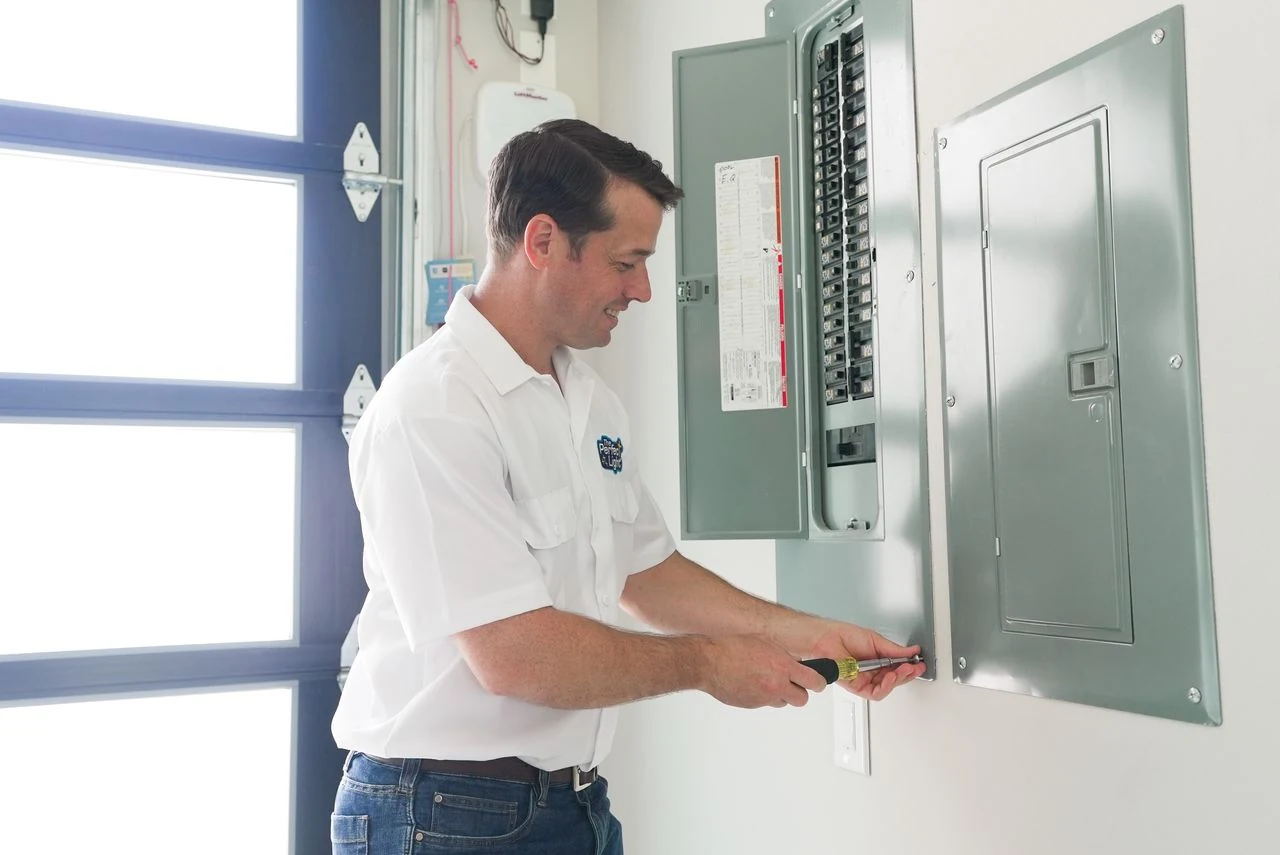
A panel evaluation is not a sales visit dressed up as a safety check. It starts with an electrician actually opening the panel, not just glancing at the outside of the box, and checking the brand, the amperage rating, the condition of the breakers, and whether the wiring inside shows any signs of heat damage or improper connections.
In Austin, that evaluation is handled by Robert Rosas, the licensed electrician on the ground for The Perfect Light, working under regional manager Micah Stevens. The company’s broader electrical philosophy, “electricians first who also sell,” matters most in exactly this kind of visit. A panel evaluation should end with a clear, honest answer: the panel is fine, the panel needs a specific repair, or the panel needs to be replaced, along with a plain-language explanation of why. It should not end with a pressured pitch for the most expensive option available.
Part of what a homeowner is paying for in an evaluation like this is the electrician’s ability to tell the difference between a panel that looks old but is performing fine and a panel that looks fine but is quietly a hazard. That distinction is not always visible from the outside, which is exactly why guessing based on the home’s age alone is not a reliable strategy.
If the panel does need work, the electrician should also be able to explain what a repair would address versus what only a full replacement would fix. Patching around a bad breaker connection is sometimes appropriate. Other times, especially with recalled brands like FPE and Zinsco, a repair is really just delaying the inevitable, and a homeowner deserves to hear that directly instead of finding out later.
What this means if you are considering a panel upgrade in Austin
Panel upgrades are not a one-size-fits-all project, and the honest answer to “what will this cost” depends on the home’s current amperage, the age and condition of the existing wiring, and whether the upgrade also needs to accommodate new demands like an EV charger or a home addition. For a closer look at how that process typically runs, see The Perfect Light’s panel upgrade service.
What does not change, regardless of the final cost, is the process. A homeowner should get a plain-language explanation of what is being replaced and why, a written estimate before any work begins, and a clear sense of whether the upgrade also opens the door to things the current panel could not support, like additional circuits for landscape lighting or an EV charger down the road.
This post is part of The Perfect Light’s ongoing series introducing its Austin electrical team. The first post in the series covered the launch of electrical service in Austin (The Perfect Light Now Offers Licensed Electrical Service in Austin, TX). For the people behind that launch, see Meet the Team Bringing Licensed Electrical Service to Austin, Texas, led by Robert Rosas and Micah Stevens, the two people actually running the Austin electrical operation day to day. If a panel evaluation turns into a bigger conversation about what else the home might need, that is the team who will be having it with you.
For the current list of cities and communities covered, see The Perfect Light’s Austin electrical service area page.
If you are unsure whether your home’s panel falls into any of the categories above, the safest move is a professional evaluation rather than a guess based on the home’s age or a quick look at the breakers.
Contact The Perfect Light to schedule a licensed electrician for an Austin-area electrical panel evaluation.
Confirm service availability in Austin
Or call the Austin office directly at (512) 379-7777.
Frequently asked questions
How do I know if my electrical panel needs to be replaced?
Signs include repeated breaker trips, warmth at the panel or outlets, flickering lights when other appliances turn on, a persistent burning smell or buzzing sound, a panel that still uses fuses, or a panel with no room for additional circuits. Any of these on their own is worth a professional evaluation.
Are Federal Pacific Electric (FPE) and Zinsco panels really dangerous?
Yes. FPE panels, common in homes built between 1950 and 1990, have documented issues with breakers failing to trip reliably. Zinsco panels, common in homes built between 1963 and 1981, have a design flaw that can cause breakers to fuse in place and fail to trip during an overload. Both should be evaluated by a licensed electrician.
How old does a home need to be before its panel is a concern?
There is no fixed age. A well-maintained older panel from a reputable manufacturer can still be safe, while a newer panel with a manufacturing defect or an undersized amperage rating for the home’s current use can be a hazard sooner. Age is one factor among several, not the deciding one.
Can I tell if my panel is a problem just by looking at it?
Not reliably. Some warning signs, like a warm panel or a burning smell, are noticeable to a homeowner. Others, like a Zinsco breaker fused to its bus bar or wiring damage inside the panel box, are only visible to a licensed electrician who opens the panel and inspects it directly.
Does upgrading my panel let me add things like an EV charger later?
Often, yes. Many panel upgrades are sized with some room for future demand, which can make it easier to add circuits for an EV charger, a home addition, or additional landscape lighting down the road without a second panel project.
Who handles electrical panel evaluations for The Perfect Light in Austin?
Robert Rosas is the licensed electrician handling residential electrical calls for The Perfect Light in Austin, including panel evaluations, under regional manager Micah Stevens.