
What actually happens to a professionally installed display during a hard freeze or ice storm, and how The Perfect Light’s 48-hour promise responds.
Ice, sudden freezes and power fluctuations can stress the connections and mounts on a Christmas lighting display, especially older or DIY setups, but they rarely take out a professionally installed system outright. The Perfect Light has built installations around Texas weather swings for 25 years, uses professional-grade materials rated for freeze-thaw cycles and backs every account with the 48-hour promise once it’s safe for a technician to get to the roofline.
Texas homeowners have been weather-aware since the February 2021 freeze, and that awareness doesn’t disappear just because the lights going up are decorative. It’s a fair question: what actually happens to a Christmas lighting system when the temperature drops 40 degrees overnight, and what’s the plan if something needs fixing?
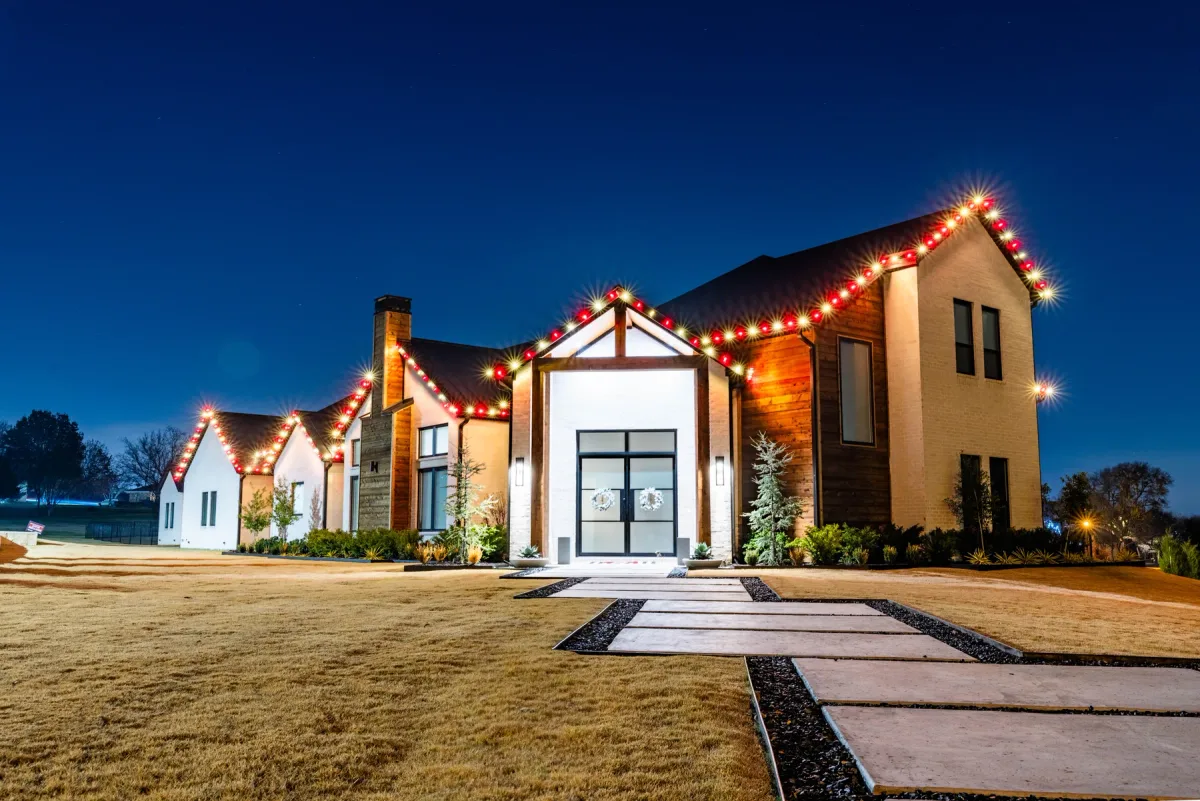
What Freezing Weather Actually Does to Outdoor Lighting
Cold doesn’t damage Christmas lights the way most people picture it. The bulbs themselves, LED or incandescent, handle cold temperatures fine. What’s vulnerable is everything around them: the plastic housings on clips and connectors contract and can become brittle in a hard freeze, extension cords and strand-to-strand connections can loosen as materials expand and contract, and ice accumulation adds weight to rooflines and gutters that the mounting system has to carry.
Power fluctuations during a winter storm, whether from grid strain or a homeowner’s own breaker tripping, are the other factor. A strand that loses power during a freeze isn’t necessarily damaged. More often a connection has simply worked loose from the temperature swing, or a breaker, GFCI device or timer has tripped, and power returns fine once that’s sorted out.
Texas presents a specific version of this problem that milder climates don’t. A single week can swing from the 70s to below freezing and back, sometimes more than once, and that repeated expansion and contraction is harder on materials than one long, steady cold season would be. None of this means a Texas winter is something to dread. It means the materials and mounting method matter more here than they would in a gentler climate, and that’s exactly where 25 years of installing in Texas conditions pays off.
Materials and Connections Built for Texas Swings
The Perfect Light uses professional-grade wire, clips and connectors chosen specifically for freeze-thaw performance, not just for how they look on day one. That distinction matters: a big-box strand built for a mild climate and a professional strand built for Texas winters can look identical in September and behave very differently in January.
Connections are secured using a mounting method designed to hold through temperature swings without stressing the roofline, gutters or fascia, the same approach used across every installation regardless of the home’s age.
This is the same reasoning behind the lifetime materials guarantee: because the materials are chosen for durability through real Texas weather, a worn or damaged strand gets replaced for the lifetime of the account.
What a Safe Response Looks Like After a Freeze or Ice Storm
A dry freeze and an ice storm aren’t the same problem. A dry freeze is mostly a materials question, connections and mounts need to hold through the temperature swing, with no added weight or moisture involved. An ice storm adds a second factor, actual ice accumulation on the roofline and the strands themselves, which is why ice events are more likely than a plain freeze to produce a visible issue like a strand going dark or a connection pulling loose.
Either way, the first move is the same, and it starts from the ground. Homeowners should never climb an icy or wet roof, pull on strands or chip ice away from mounted lights to investigate a problem themselves, even if the issue looks minor. Access conditions during ice are often more dangerous than whatever’s wrong with the display. Look for what’s visible from a safe distance, a sagging strand, a section that’s come loose, a damaged gutter, lights that no longer turn on, and report it to the team rather than climbing up to check.
If something does go dark, most post-freeze issues are a loose connection, not a failed strand, which is why a quick service visit resolves the majority of calls that come in after a hard freeze. A technician checks the connections most exposed to temperature swings, confirms the power source and breaker are solid, and reseats or replaces whatever worked loose.
If a tree limb, gutter or other part of the property has been damaged by the storm, that gets addressed before the Christmas lighting, and any issue that looks like it involves the home’s permanent electrical system rather than the temporary display should go to a qualified electrician.
The 48-Hour Promise During a Weather Event
Every Perfect Light Christmas lighting account includes the 48-hour promise: once conditions are safe for a technician to reach the display, the issue gets addressed within 48 hours, and the homeowner doesn’t need to be home for it. During a widespread weather event, crews prioritize by severity and safety, so a major regional freeze or ice storm that affects thousands of homes across a market can mean the 48-hour clock starts once it’s safe to be on a roof, rather than the moment the storm hits. That’s not a loophole in the promise, it’s what keeps the promise honest: a crew climbing an ice-covered roof isn’t a service standard worth keeping.
The promise exists because The Perfect Light owns the install, the materials and the service, start to finish. There’s no third party to coordinate with and no separate invoice to negotiate. A homeowner calls, reports the issue and a technician handles it as soon as it’s safe to.
What the Lifetime Materials Guarantee Covers
The lifetime materials guarantee covers worn or damaged materials for the life of an active account, which includes the ordinary wear a Texas winter puts on connections and mounts year after year. The straightforward answer for a homeowner either way is the same: report what you’re seeing, and the team will walk through what the current guarantee covers for that specific situation.
What doesn’t change is the approach behind it. Twenty-five years in Texas has taught the difference between promising immunity, which nobody honestly can, and promising a fast, no-hassle fix once it’s safe to make one. That’s the promise worth keeping.
Book a design consultation.
Christmas lighting program or call (972) 445-9820.
Frequently asked questions
Do you service Christmas lights during a winter storm?
Yes, technicians respond to service calls during winter weather, but a widespread freeze or ice storm that makes roofs or roads unsafe can extend response times beyond the usual 48 hours while the team waits for safe working conditions and works through higher demand across the service area.
Will my lights still work after an ice storm?
Often, yes. Professional-grade connections are built for freeze-thaw cycles, and the majority of post-storm issues are a loosened connection rather than a failed strand. If something does need attention, report it and a technician will address it once conditions are safe.
Do I need to take my lights down before a predicted freeze?
No. The Perfect Light’s installations are designed to stay up through normal Texas winter conditions, including hard freezes. If an unusually severe event is forecast, ask the team whether any special steps make sense for your specific display.
What’s the difference between a DIY setup and a professional installation during a freeze?
Consumer-grade strands and connectors aren’t always rated for repeated freeze-thaw cycles the way professional-grade materials are. A DIY setup is more likely to show loosened connections or brittle housings after a hard freeze, where a professional installation is built around that exact weather pattern from the start.
Is an ice storm worse for Christmas lighting than a dry freeze?
Generally, yes. A dry freeze mainly tests the connections and mounts through temperature swings. An ice storm adds the weight and moisture of actual ice accumulation on the roofline and strands, and it also makes the roof itself unsafe to access, which is more likely to produce a visible issue and can delay a service visit until conditions clear.
What should I do if a section of lights goes dark after a storm?
Check only what you can safely see from the ground, confirm whether the house and outdoor circuits have power, and report the issue to the team. Don’t climb an icy roof or repeatedly reset a breaker that won’t stay on. If the problem looks like it involves the home’s permanent wiring rather than the display, that goes to a licensed electrician.